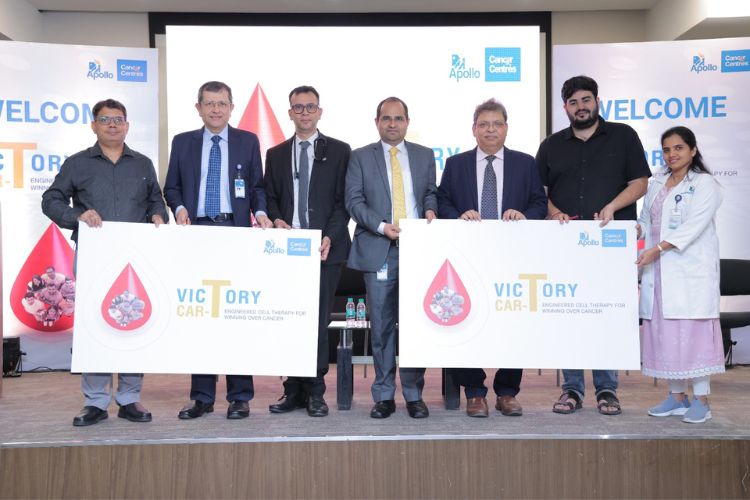
For 49-year-old Mrs. Sharma from Odisha, the ticking clock of cancer left little room for hope. Diagnosed with an aggressive form of blood cancer—acute B-cell lymphoblastic leukemia—she had exhausted most treatment options. Similarly, Mr. Das, a 57-year-old Mumbaikar with relapsed follicular lymphoma, had tried it all—chemotherapy, radiation, and still faced relapse after relapse. But what doctors at Apollo Hospitals Navi Mumbai offered wasn’t just another treatment—it was a last shot that worked.
Both patients were given a new chance at life through an advanced immunotherapy known as CAR-T cell therapy—considered one of the most revolutionary cancer treatments in the world today. What makes it even more remarkable? The treatment used was developed right here in India.
Under the guidance of Dr. Punit Jain, Consultant Hematology and Program Coordinator of BMT & CAR-T cell therapy, the hospital used the patient’s own T-cells—immune cells that are genetically modified in the lab—to recognize and destroy cancer cells. The process is long and intensive: cells are extracted, re-engineered with chimeric antigen receptors (CARs), multiplied in a lab, and then reinfused into the patient after a preparatory chemotherapy phase.
But as the science unfolds, the human stories steal the spotlight.
“The therapy was intense,” said Mrs. Sharma, “but the support from the Apollo team helped me stay strong. I can finally see a future now.” She was discharged weeks after the procedure, her recovery being closely monitored.
Mr. Das, who had almost given up after years of failed treatments, now walks with renewed determination. “CAR-T cell therapy gave me hope again. I feel I’ve finally turned a corner,” he said.
Apollo Hospitals Navi Mumbai isn’t new to complex cancer care. It has consistently delivered bone marrow transplants with success rates comparable to global standards, including treatments for international pediatric and adult patients. However, the CAR-T cell breakthrough represents a new chapter—one that promises long-term remission for patients who had run out of time and options.
“CAR-T is a game-changer,” said Dr. Jain. “It offers the possibility of a complete cure for patients with treatment-resistant cancers. We’re proud to bring this to our patients through high-quality, evidence-based care.”
This success, while rooted in advanced science, rests heavily on a network of compassion, precision, and persistent effort—from doctors to lab technicians and nursing staff.
As cancer continues to be one of the leading causes of death in India, stories like that of Mrs. Sharma and Mr. Das remind us that innovation in medicine isn’t just about machines and molecules. Sometimes, it’s about reigniting hope where there was none—and rewriting someone’s story of survival.